Friday, 21 February 2025

What do school students think: Does patriarchy impact boys and men as well?

 We have been engaging with the students of various schools nearby Khushipura village, Aligarh on the issues of gender, patriarchy, rights and challenging violence along with Sahasi Girls program to build safe spaces for adolescents in Educational spaces as well. In continuation with the session of gender, this time we facilitated a workshop on ‘Gender difference in everyday lives’ with the students of the Public school in the village itself where 20 participants were present.


The workshop began with the brief introduction, intention setting and reiteration of agreements so that everyone gets an opportunity to share and listen. It was a happy surprise that most of the students remembered and could define gender. Building on their understanding, we divided the participants into 4 groups and invited them to discuss and write the gender differences they see in different spaces on daily basis. It was interesting to see that 2-3 students took initiative to form a group with both boys and girls participants.


I went to the group where gender differences in home were being discussed. On asking who does most of the work in home; one of the participants said that it is the father who does most of the work. I asked her to explain a bit more.

‘Papa works very hard in the agricultural fields. He brings money for the family.’

‘But the farming is for 7-8 months. What about rest of the months? What about your mother who cooks 3 times a day for 12 month?’ This question stuck the cord and another participant shared, That’s what I wanted to say. Mother also brings food to the father and others working in field, takes care of children, provides fodder for the buffaloes, clean them up. She always listens to me and also helps papa during harvesting season.’

And this way one participant deconstructed the gender for other in the same group. This conversation also reminded me once again how women’s work and contribution is taken for granted, remains unpaid and because metaphorically she doesn’t bring money from outside – the devaluing of her work continues casually hiding behind the gendered behavior.


The process of understanding gender or unlearning gender norms is a time taking process, this assumption that participating in one workshop or few workshops can empower young people or adolescents to not only understand but challenge gender biases is a myth and harmful for their well being. That pressure shouldn’t be on them, something that has been building over thousands of years, cemented into our lives in a way that it is difficult to even see what gender norms are doing not only to us but everyone at large can be daunting, challenging and many times seemingly an impossible task.  That is the reason why we at Sahas engage on gender issues with adolescents and young people slowly, step by step exploring the various aspects of it and peeling the layers that are overshadowing what could be their vision for life beyond the barriers of gender and violence.

Each group then shared their learning with the larger group –

Home –

·    Mother cooks food, cleans house, washes clothes and take care of children. Elder sister helps mother in household chores. Older women sometimes take care of small children, shares stories. The father does work in fields, also handles livestock.

·     Most of the time boys are on phone either watching videos or playing games. Whenever papa asks them to do something they make excuses. The girls spent their free time in putting mehndi, roaming around or using phone while mothers keep working in home.

·      ‘We should not discriminate because both mother and father work equally’


Leisure

This group wrote all the things that the boys do in their free time – they play games, use phones, watch YouTube videos, and engage in fighting with each other. None of them had any idea as to what girls do in free time. To this one of the girls shared that they don’t get free time as such because if they are even seen sitting idle for a while, people start taunting and immediately they are given some or the other work.

School –

This group extensively brought out the gender differences they see in school spaces.

·      Boys chose to take maths while girls take home sciences in high school.

·   Boys are punished more harshly and are made murga while the girls are asked to simply raise their hands

·     Boys and girls are made to sit separately and they don’t talk to each other that much.

·      Both boys and girls play different games; boys play cricket while girls play kho kho.

·     Boys feel shy while talking to mam but the girls feel shy talking to both mam and sir.

·    The girls don’t get opportunity to study till higher classes. Even if someone sends their daughter to study further, the villagers talk behind them, spread gossip about girls.


Taking cue from these sharing, the facilitator reiterated what gender actually means, and how deep rooted it is in the society which restricts girls and women and gives certain privileges to men and boys. With the discussion on access and control over resources, land, money, decision making and mobility, the facilitator defined patriarchy and how it further increases the divided leading to gender discrimination and violence against women and girls.

The facilitator further probed that from this discussion, it was clear that patriarchy impacts girls and is harmful for them so they need to challenge it but does it impact boys negatively?

The boys unanimously said NO! The facilitator said that if it doesn’t affect you, it gives you so many privileges then the system is good and you won’t want to change it?

She further asked – ‘Can you cry if you are hurt?’

‘Can you refute the responsibilities and expectations of family? How does that make you feel?’

There was complete silence from boys over these questions yet so much to say which was quite visible! On prompting, there was slight sharing on how there's expectation for boys to be always strong and cannot express their emotions rather be angry and stand firm. They have to study hard to fulfill family responsibilities no matter what.  This way we could explore with the boys that it affects them as well and challenging this system of patriarchy is important for everyone.


 It was positive to see that we could take the conversations into exploring how boys and girls can support each other and move towards the idea of gender equity. 


Sexuality, Body autonomy and Decision making

‘I would rather be killed by the wild animals here than being hugged, touched or harassed by a man. In this way, no harm will be done to my family’s honor and respect. If something like this happens, what will people say to my family?’ – says 15 years old girl and most of the girls in the room agree with her during the workshop on ‘Body and sexuality’ conducted in the Khushipura village.


This is how deep rooted patriarchy and gender is in our society! The family where boys are given preference over girls, they are made to do household chores from as early as 7-8 years, then their education is stopped giving various reasons like lack of money, fear of society, fear of girl being harassed or as simple as the one ‘what will you even do after getting education?’, all the decisions are taken by others; and for them the girls are ready to give away their lives in order to save the superficial honor of the family. This is not a fiction story or something that I have read in books but have witnessed over years of working in the villages and mind you this isn’t just the story of one state of India. For this extremely appalling statement – who is responsible?  Who have made such young girls believe that their lives are not worthy enough? Many people would jump on the train to initiate intellectual discussion or finding solution over this but how many of us will stop, just pause and hear this statement! How many of us are willing to listen to the girls, who doesn’t even know how grave is their suffering and wonder pain, agony and trauma of it.


I remember this gentleman who must be working in some Nonprofit casually commenting on the post I made for this session on social platform saying that I am using boys as scapegoat for the conversation on gender, lecturing me to share examples from girls in city to engage on gender equality because capacities of boys and girls are different. Interestingly every time I talk on Gender, privileged people tends to feel entitled to share their privileges and ignorance rather than seeing the larger problem. It is high time, people educate themselves and understand that everyone irrespective of where they stand in the society need to come forward to address their inner biases and only then there could be some real progress in gender equality. And if I have to shout out again then so be it – ‘Gender is not just women’s issue’.

The workshop on ‘decision making’ with the girls had left them with some major questions to think through and reflections on their lives. Continuing on the same lines, the next session with the girls focused on ‘body autonomy and sexuality’. The facilitator began with a brief introduction, intention setting for the session and reiterating basic agreements so that we have safe space where each of us can share, question and listen to one another without feeling threatened or judged. In the first part of the session, the participants were invited to share about how did they first come to know that they are a girl? There was pitch silence, and a huge question on everyone’s face probably indicating that isn’t it obvious or they have never thought about it. Then slowly with probing, they started thinking and writing on the chits. Some of the reflections were –

‘I was told not to go outside because I am a girl’

‘My mother told me that you are a girl so don’t talk to other people that much. What will people say?’

‘My brother constantly tell me not to sit idle, do something because I am a girl’

‘I came to know that I am a girl when my parents told me not to go outside’


‘My aunt told me that you are a girl, you should do household chores.’

‘My family members used to say that you are a girl, you should know household work otherwise what will you do when you go to other house’

‘People always comment whenever I go out, they say look that girl is going there and there’

‘The way we are addressed, with the name and the way people always tell us to do something or not do something indicated that I am a girl.’

We wanted to explore the uninhibited desires, aspirations of the girls so we thought to tweak the question a bit and ask – If I was a boy? We have been working with the girls since Dec. 2020 and whenever we have asked them the question on their dreams and aspirations, the answers were quite limited and that’s why we thought why not let them complete this statement. To our surprise, the first few responses were same that they would study in good school or college or would go to the city and work! Imagine this strong desire to study and do work while many people/students complain about the same in the cities.  Slowly they opened up –

‘I would never wear dupatta’

‘I would be able to get uninterrupted sleep, no one will wake me to do household chores’

‘I will never miss any of my friend’s parties’

‘I will go to barat and never miss the fun’

‘I will go and travel to different places’


‘I won’t have to ask for anyone’s permission for doing anything’

‘I will go to the city and study all by myself’

‘I won’t do any household chores’

‘I would support my sister and take her wherever she wants to go, and support whatever she wants to do and never hold her back’

‘I would be on phone throughout the day’

‘I won’t go to the fields to throw cow dung.’

‘I won’t get periods! I am so sick of pain and all the things that come with it.’ Many girls did hurray on this statement.

‘I would be able to marry according to my wish and also won’t have to leave my house’

‘My parents would have supported my education.’

We moved to the next activity leaving the girls with the question – ‘What is stopping you to fulfill these desires?’

Through storytelling, the facilitator engaged on body autonomy, sexuality and decision making. Many of the girls chose the path to their village from their college that crosses the forest which may have wild animals in the late evening. Interestingly none of them have ever been allowed by the parents to even go to house next door in the late evening forget about going to the fields alone. On asking where did they find strength because people believe girls are weaker; few of them said that it isn’t necessary that they will find animals or even if they would, they will fight them! Both of them being unrealistic – it is here when one of the participant said that it is better to die that to engage with men because parents or people in the society will curse them or question their honor.


Some of them chose the path that has a house where a man who is accused of sexually abusing girls lived. Their reasons being that he might not do anything to them or they will be able to trick him. The last few girls chose to hug the boat person in the hope that it is a brotherly hug. On asking whether their brother has ever hugged them – there was a big NO. This storytelling led to several questions related to marriage, family’s honor, decision making being gendered and how sexuality of girls and women are oppressed so much that they themselves have hard time making choices related to their bodies on free will! This question is embedded in their bodies – what will people think, what family would say or if I do something than it will tarnish the honor family! How much pressure or control patriarchy has over women’s body and why are we teaching these things to young girls. As an adult, I feel ashamed on behalf of the society!

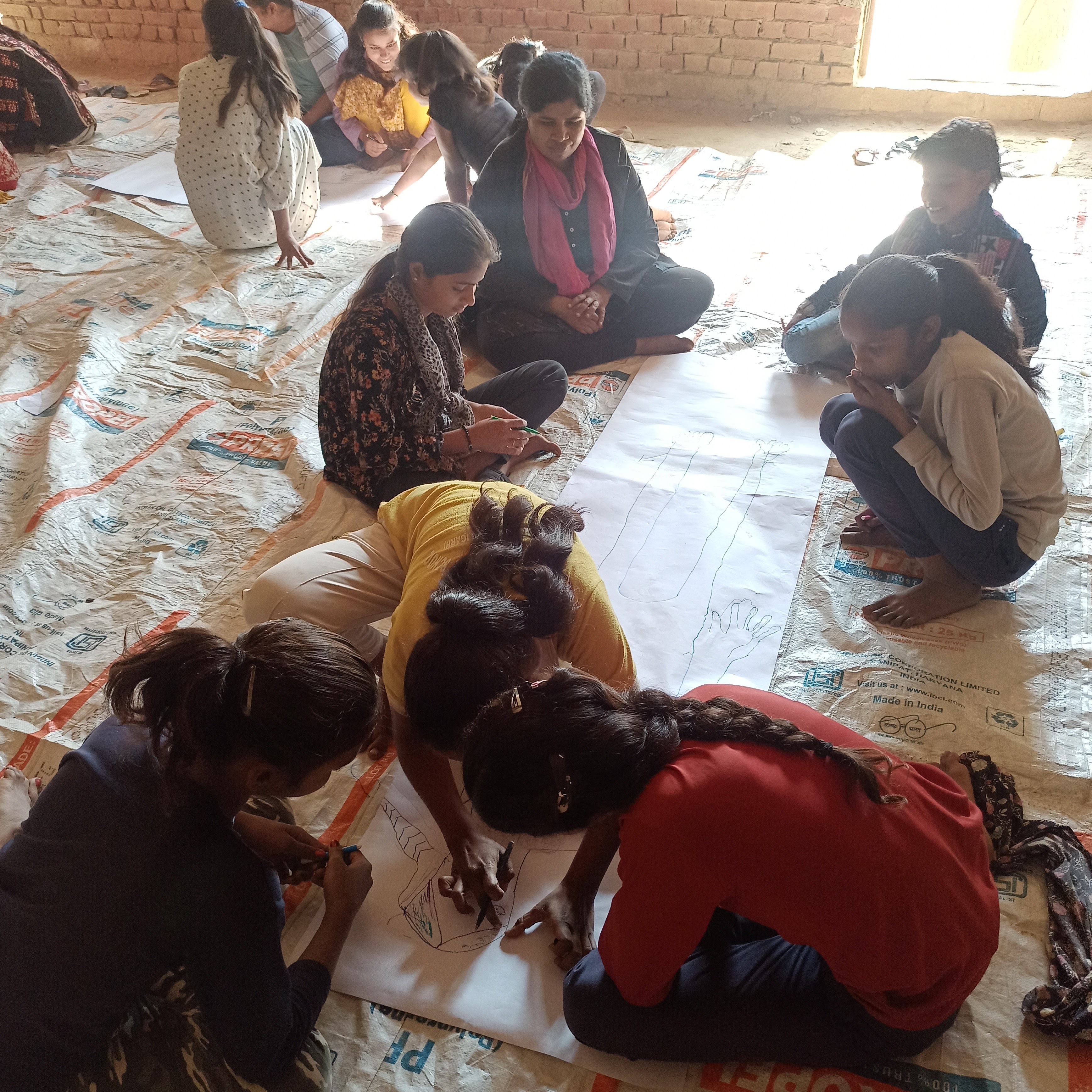
The girls were then divided into the groups to create body maps and answer subsequent questions. To our surprise, all the groups including the younger ones were able to name the body parts including the sexual organs and the changes that happen during puberty in their bodies. While there was no hesitation on sharing which body parts are related to shame, it took them sometime to share which parts give them power however no one of them wrote which body parts are associated with happiness.  All of us observed the body maps of each group one after another with one core member explaining their maps with the answers.


Since the activity was intense, we did a feel check. One of the participants shared that her mind is still in the last activity thinking about what decision is the right decision. Another participant shared that she is excited to know what happens next!

The facilitator then taking cue from the story telling and body map activity discussed with examples the intersection of body, gender, desires, decision making, rights and sexuality. This is where we engaged on various incidences in the village where the girls were shamed, abused and looked down upon due to gossips or them talking to a boy or having phone. Recently in one of the school in the village, the Principal shut down the classes for girls who are studying in 10, 11 and 12th because of the rumors that one of the girls had telephoned a teacher. This rumor was spread by one of the girls only, and the other girl kept crying but no one believed her. The principal’s exact word to me was ‘Wo toh ladhki hi kharab hai. Hum apne school ko badnam nahi karna chahte.’ If the educator says that, what can you expect from others?


One of the participants shared that, ‘We didn’t even engage in the rumor. But he scolded us in front of others and told to just go home. The girl who spread the rumor wasn’t even scolded or punished and her classes are going on.’

We also talked about last year incident where girls in the Sahasi Girls program fought with each other because someone said that her parents have told not to speak to other girl because she talks to boys. How is talking to boys is a crime and why boys are never scolded for talking to girls! Why girls and women find it easy to spread rumors about other girls. Why Sahas team was called names, ambushed and people had spread rumors about them? There was also mention of the brutal crime where a girl was allegedly murdered by her in-laws from this village; her family settled the case by accepting the money from the in-laws. It was an important reminder for the girls to unfortunately think about themselves a little more and participate in decision making!  The discussion dived into the why of all of this – which is to control girls, their bodies and freedom of expression and it is easy to defame them in the name of respect and honor. Once we understand this basic thing that everything is about controlling women’s body and sexuality, we will be able to deconstruct gender norms, challenge violence and take back the control of decision making. There can be support but one need to find in themselves that what is happening to them isn’t right and they have to find a way!

One important statement by the facilitator that girls found interesting – ‘Just because it has been going on forever or since ever, and just because everyone is doing it doesn’t make it right!’


The session closed with culminating the learning from the different sessions – gender, gender differences in daily lives, patriarchy, decision making and the current one and invitation to reflect these learning in their own lives. It was clear from the faces of the girls that the thinking mode has started because they were discussing the stories and experiences in the small groups while leaving for home. 


Tuesday, 11 February 2025

Decision making and Championing girls rights in rural India


Other people - family and relatives take the decisions for us, girls! They think girls don’t have the capacity to make good decisions. More specifically, others think that girls will not say NO to the decisions made by the family for them.


We have been engaging with the girls in Khushipura village through Sahasi Girls program on various issues specifically gender and education. While the girls have understood the importance of education and have started reflecting on gender norms and discrimination in their lives, they are still struggling with making choices and decision related to their life. Honestly, for them, making decision or having a say in decision making related to education, mobility and marriage is not a reality. With this context of the girls and some of the recent decisions made by them, we facilitated a workshop on ‘Decision making and girls leadership’ this Sunday. The workshop started with brief introduction and agreements emphasizing that today they have to bring all their energies and mind in the workshop. Through a simple activity of morning routine, we engaged on how individuals make small and big decisions within a day; some doesn’t require much thought but some require lot of thinking.  And that’s why understanding decision making is important.


In the next activity of snap decisions, we asked questions (in the form of this and that, choices and some what would you do?) and invited the girls to answer them swiftly. For some of the questions, the answers came immediately but some took time. It was clear that decisions related to education, marriage and body were difficult to answer. With this activity, we engaged on why some decisions are easier to take and some not. The facilitator took some time to explain that consequences and influence of other people make these decisions difficult to take. For example – most of the girls while thinking about education, doesn’t leave village for college because they fear whether parents would give permission or not, what will villagers say, what if I don’t take transport, or will I be able to study in the college and so on. However none of us actually weigh it with the positive consequences like there will be regular classes, qualified teachers, they will be able to interact with girls from other villages or city or what if they are able to challenge their inner fear and develop confidence.  One of the girls said that marriage is not in their hands, they will have to do as they are told by their parents.


This conversation made the girls pause and there was tension in the environment because many of the girls will be facing the same situation in a year or two. Second thing that surprised us was the response on ‘what will you do if you get periods in the school’ – the participant said that they will go home immediately. We have engaged with the girls on reproductive system and periods, especially on challenging the shame around it. There are many Sahasi Girls who go to same school and three female teachers who have participated in our sessions – instead of seeking their help or asking for pad, if the student still thinks that they need to go home that reflects as to how shame and stigma around menstruation still exists.


There was a crucial moment in the workshop when one of the facilitator conducted a poll with 5 questions around education, work, money and marriage and who takes those decisions. There was absolute silence and no one raised their hands to say that they take those decisions for themselves! Clearly there is huge influence of the family with no conversations and consent of girls on those decisions. This led to an interesting discourse dwelling deeper into the absence of girls voices, consent in decision making which is rooted in gender and patriarchy as boys do have all the freedom to take their decisions but, girls don't have that. We also connected it to their previous session on gender difference in different spaces, where none of the participant actually mentioned about decision making especially when it comes to household. This was quite an intense and heavy discourse on gender and decision making, so we did a feel check; the girls had haunted look on their faces and they looked quite down because what they were going through and were largely ignoring – now they had no choice but to come face to face with the harsh reality. We paused and took long deep breathes to be present.


The girls were then divided into 4 groups; each group was given a story where they had to decide whether the decision taken by the girl in the story is right or wrong, what were the consequences of those decisions and now if you were to support her in the decision making what can you tell her? Importantly these 4 stories were from the girls enrolled in Sahasi Girls program itself. For two stories, they were able to critically analyze the issue with decision making however the responses in the other two cases left the facilitators shocked. For the first story, they said it was right decision to take admission in the college even if there are no studies and the students go there to give exam because her parents said so. More shocking was about the girl who unfortunately drop out of school due to her mother’s prolonged disease, despite getting a chance she makes a decision not to go back to the school. The participant said that her decision was right, how will she cope up with the studies in the school, it has been so long. Second one said that the decision was right also wrong as well because she has responsibilities, she might not fit in the class or won’t understand what is being taught in the class and what if her parents don’t agree.


As a facilitator and mentor, it was challenging to hear the girls say these things. On asking if this decision had any consequences, they unanimously agreed that it had bad impact on her life leaving it ruined. So how is that decision right? With this, we engaged on understanding how decision making is critical for the girls be it their day to day life, education, work or marriage as they are the ones who are leading that life and will bear the consequences of it and no one else. Secondly, we took this moment to reiterate that this is a safe space where they raise their concerns, share questions and needs but they spend most of the time in their homes if they don’t build the courage to speak to their family and make their voices heard in the decisions concerning their lives – then they have to reflect on what they are learning or what they want to do with their lives?  


Also, for them to lead their life and make changes in the society they need to stand in solidarity with other girls. If you keep moving ahead and not bothering about your fellow girls then also it is time to reevaluate and reflect! The facilitator and Sahas team also shared the difficult decisions they had to take to continue the work despite constant resistance from the villagers including the family members of some of the Sahasi girls. It was reiterated that this life is yours and no matter who takes the decision, it is you who is living that life, you will be the one to bear the consequences so why not take the reins of your life in your own hands.


Purvi Yadav closed the session by saying, ‘You are the main character of your story. Don’t ever let anyone else define you!’  After an explosive and intense conversation on decision making, we all sat down and relished on fresh oranges.


Monday, 16 December 2024

हकीकत है, वो स्याह रात की कहानी

कहानियों में था सुना,

किस्सा काली भयावक रात का

गड़गड़ाते बादल, सुनसान रास्ता, दरिंदगी राक्षस की

लेकिन ये रात तो आम रात सी थी

न सुनसान न अकेली

दिल्ली जो सोती नहीं,

मूंद ली उसने भी अपनी आंख

क्या पहना था उसने?

थी किसके साथ वो?

इतनी रात को क्यों घूमती अकेले?

कितनी बातें कितने सवाल

हैवानों से मांगी होती माफी, बनाया होता भाई

कहता झूठा सन्यासी।

क्यों कभी सवाल नहीं उठा राक्षस पर

बीत गए 12 साल,

पर क्या आया अन्याय की गुफा में सवेरा ?

घर, दफ्तर, सड़क, बस

गांव, शहर

बच्ची, किशोरी, महिला या बुजुर्ग

शिक्षित, अशिक्षित

हर रोज हर घंटे

बनती दरिंदगी का शिकार

अब भी कहते हो बेटी पढ़ाओ बेटी बचाओ

लानत हैं तुम्हारे दुस्साह पर

हर उस इंसान पर

हर उस व्यवस्था पर

उन सिस्टम पर

जो बने मूकदर्शक अन्याय के

उन सभी पर

जो दुहाई देते बदलते समाज की

लड़कियों तो लड़कों से आगे हैं

नेता भी महिला, पुलिस भी महिला

हवाई जहाज चलाती महिला

अंतरिक्ष में परचम लहराती महिला

लेकिन अनदेखा करते स्कूल जाती सहमी छात्रा को

दफ्तर से देर शाम लौटती महिला को

कार्यस्थल पर कम बोली युवती को

ट्रेन में कभी अकेले तो कभी परिवार के साथ

सफर करती लड़की को

सिस्टम में खोट निकालने वाले

न्याय व्यवस्था पर ठिकरा फोड़ने वाले

खुद के गिरेबान में झांको जरा

कब कब तुमने मूंदी आंखे

कब कब अनसुनी की उस चीख और चुप्पी को

खुद कितने बार उड़ाया माखौल

खुद कितने बार बोली अन्याय की जुंबा

हकीकत है वो स्याह रात की कहानी

उठो, जागो, खोलो आंखे

जब तक नहीं बढ़ेगे सभी के हाथ

जेंडर आधारित हिंसा के खिलाफ़

नहीं खत्म होगी ये अंधेरी रात, भयावक रात।